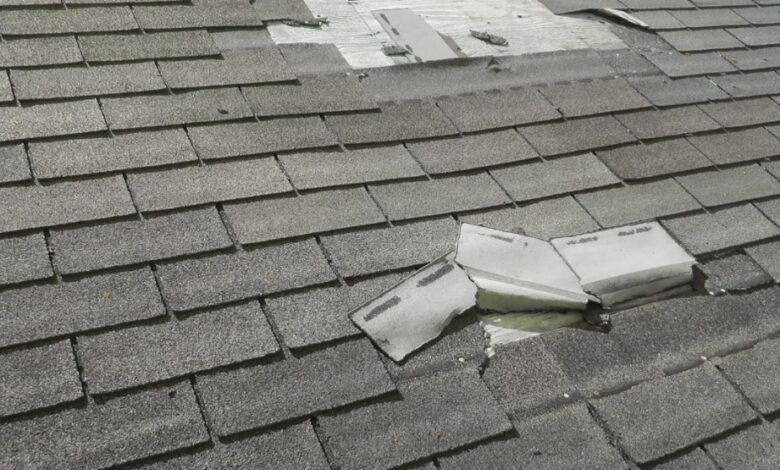
TLDR: Hail damages roofs by removing granules and compressing the asphalt mat in shingles, reducing their protective life by 5 to 10 years per significant storm. Wind damage lifts and removes shingles, exposing the deck to water. Colorado ranks among the top five states for hail insurance claims annually, with average claim costs of $12,000 to $18,000.
Hail damages a roof by impacting the asphalt shingle surface with enough force to dislodge granules and compress the fiberglass mat beneath them. Wind damages a roof by lifting shingles at their edges, breaking the adhesive seal strip, and either partially lifting or fully removing shingles from the deck. Both types of damage shorten remaining roof life and create conditions for water intrusion that may not be immediately visible but appear within one to two seasons.
Colorado ranks among the most hail-active states in the country. The Insurance Institute for Business and Home Safety identifies Colorado as a top-five state for hail claim frequency, with average claims between $12,000 and $18,000. Insurance claims involving roof damage often require clear documentation of the affected areas and the extent of the loss.
Homeowners in Berthoud and across the Front Range commonly work with the best roofing company Berthoud Colorado, for post-storm assessments that include photographs, inspection findings, and supporting documentation for adjuster review.
How Does Hail Actually Damage a Shingle?
Asphalt shingles protect the structure beneath them through a layered system: a fiberglass mat provides structural integrity, asphalt provides waterproofing, and granules protect the asphalt from UV degradation.
A hailstone impacts this system with kinetic energy proportional to its size. A one-inch hailstone falling at terminal velocity hits a shingle surface with approximately 2.5 to 3 foot-pounds of force. A two-inch hailstone hits with 10 to 15 foot-pounds.
The result of that impact:
Granule displacement: The granule layer is physically knocked off the impact point. The exposed asphalt mat loses UV protection and begins degrading immediately. Without granules, the asphalt layer loses flexibility, becomes brittle, and develops cracking within one to three years, which still relies on UV exposure.
Mat compression: The fiberglass mat beneath the asphalt is compressed by the impact. This compression cannot be reversed. The mat’s structural integrity is compromised at the impact point, reducing the shingle’s ability to resist wind uplift.
Adhesive strip damage: The thermal seal strip on the leading edge of each shingle is the primary wind resistance mechanism. A hail impact directly on the seal strip can compromise its adhesion, creating a shingle that looks intact but lifts under wind load.
How Does Wind Damage a Roof?
Wind damages roofs through uplift forces that exceed the design resistance of the shingles and their attachment.
Most residential shingles are rated to resist 60 to 130 mph winds, depending on the product specification. The weak point is the seal strip. When wind gets under the shingle edge, it creates a pressure differential that can lift the shingle even at speeds below the rated threshold if the seal strip has been weakened by age, cold temperatures, or previous hail impact.
Primary Wind Damage Patterns
Tab lifting: Three-tab shingles curl upward at the leading edge. If wind is sustained, the entire tab separates from the shingle body.
Shingle removal: Complete shingle removal exposes the underlayment, which is not designed for prolonged water exposure. Underlayment typically fails within one to two seasons of direct weather exposure.
Ridge cap loss: Ridge cap shingles are the most exposed component on the roof. They are the first to show wind damage and the last to be installed during replacement.
What Size Hail Causes Insurance-Qualifying Damage?
Insurance companies generally classify hail damage as a covered loss when hailstone diameter reaches one inch or larger. Below that threshold, damage may be limited to granule loss that does not qualify for a claim under most policy terms.
The actual impact threshold depends on shingle age and condition. A shingle at the end of its expected life may sustain claim-qualifying damage from smaller hailstones because its granule layer and mat integrity are already compromised.
Colorado’s most active hail corridor, which runs from Colorado Springs through Denver to Fort Collins along the Front Range, averages several significant hail events per year. A single storm with golf ball-sized hail (1.75 inches) produces average shingle life reductions of five to seven years per storm, according to industry actuarial data.
How Do You Know If Your Roof Has Storm Damage?
Signs visible from the ground:
- Missing shingles
- Shingles lifted or curled at the edges
- Visible dark spots or exposed mat on shingle surfaces
- Granule accumulation in gutters after a storm (not normal granule shedding)
- Dented or bent ridge cap shingles
Signs that require roof-level assessment:
- Circular impact marks with missing granules at the center (classic hail damage pattern)
- Soft spots in the shingle mat at impact points
- Lifted seal strips that are visible when the shingle’s leading edge is raised
- Flashing displacement from wind load
A professional inspector with experience in insurance documentation can distinguish between normal wear and storm-caused damage, which is the key determination in whether a claim is approvable.
What Does Hail and Wind Repair Cost?
| Damage Scope | Repair Cost |
| Minor hail (localized, <10% surface affected) | $300 to $1,500 |
| Moderate hail (25 to 50% surface affected) | $2,000 to $6,000 |
| Severe hail (total replacement required) | $8,000 to $20,000+ |
| Wind: 1 to 10 shingles replaced | $150 to $600 |
| Wind: ridge cap replacement | $500 to $1,500 |
| Wind: full shingle section replacement | $1,000 to $4,000 |
When hail damage is claim-qualifying, the insurance settlement typically covers the replacement cost value of the roof minus the deductible.
Homeowners with an actual cash value policy (rather than replacement cost value) receive a payment reduced by depreciation based on the roof’s age.
What Is the Claim Filing Timeline?
Most homeowner’s insurance policies require storm damage claims to be filed within one year of the storm event, though some policies have shorter windows. Colorado has a two-year statute of limitations for insurance claims on property damage, which is longer than in many other states.
The practical timeline for best outcomes: inspection and documentation within 30 days of the storm, claim filing within 60 days, and repair scheduling as soon as the claim is approved.
Delays in documentation allow the insurer to argue that some damage resulted from subsequent weather events rather than the original storm, which can complicate or reduce the claim.
Key Takeaways
- Hail removes granules and compresses the asphalt mat in shingles, reducing remaining roof life by 5 to 10 years per significant storm, regardless of whether interior leaks are immediately present
- Wind damage works through the seal strip: weakened adhesion from hail impact, age, or cold makes shingles vulnerable to wind speeds below their rated threshold
- A one-inch hailstone diameter is the general threshold for insurance-qualifying damage; the actual threshold depends on shingle age and existing condition
- Colorado’s Front Range averages several significant hail events per year and ranks among the top five states for hail insurance claims
- Average hail claim costs in Colorado range from $12,000 to $18,000; total roof replacements on large homes can reach $30,000 or more
- Document storm damage within 30 days and file a claim within 60 days for the clearest path to full claim approval under most Colorado policies
Hail and wind are not abstract weather events for Front Range homeowners. They are a recurring budget variable. Knowing how these events damage your roof and what the repair process looks like puts you ahead of the claim timeline when the next storm rolls through.